Directors
Nathan Fielder
Lance Oppenheim
Starring
Nathan Fielder
Elizabeth Holmes
Billy Evans
Amanda Seyfried
A disclaimer: every review I pen is a post-watch analysis, a critical debriefing that unpacks themes, decisions made, and the overall impact of the movie in question. As such, I have a hesitancy to review documentaries. Partly because they’re penned in an entirely separate, reverse manner, partly because the subject matter and presentation can be so very different to fictional filmmaking. That said, there are often exceptions, like American Animals, that blur the lines and divert into the more conventional realms of moviemaking. And as You Can See Everything is such a singular, unique experience, it warrants exploration – albeit in a somewhat different format.
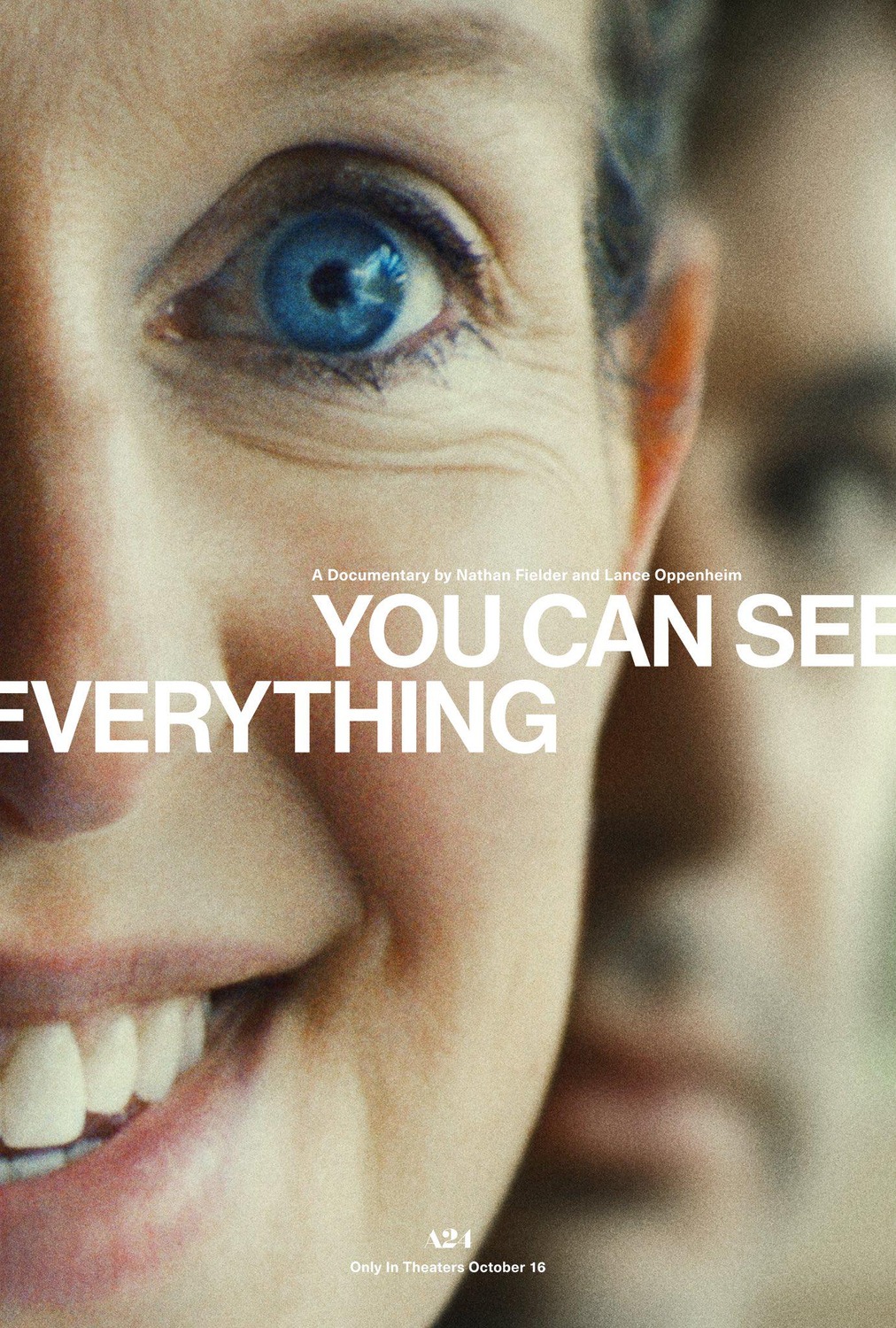
In the mid 2000s, a young Elizabeth Holmes pioneered revolutionary technology (Theranos) that could perform any number of blood tests while only drawing a single drop of blood. After a decade of failing results, it became apparent that Theranos wasn’t all it was purported to be. Holmes and her then partner were charged with various crimes and sentenced to prison time. At the height of the trials and scandal, Holmes met her current partner, Billy Evans. The pair had two children together, set out to fight Holmes’ case in the court of public opinion, and essentially began the process of restarting the research efforts. Part of that rebranding was the agreement to do this documentary.
In truth, I don’t think Oppenheim and Fielder had a specific agenda going into this film. I believe that the more time the crew spent with these individuals, the clearer it became that they were being manipulated and deceived. To that end, you start to feel this is a story of ego and hubris; a cautionary tale for those trying to write and steer an account who, in the process, end up architects of the most painfully exploratory exposure. More than that, we’re witnessing a quietly hostile chess match and as it continues to unfurl, there’s a sense of intrusion. Despite the cameras and microphones recording every moment, and the constant insistence that they have nothing to hide, there’s a trampling on something uncomfortably private. As if they’re all simply taking advantage of one another. Which, admittedly, could be down to tone.
From the outset, this film is shot and cut like a psychological thriller – most notably through Ari Balouzian’s score, which sometimes feels like a Hitchcock release. But putting tonality and vibes to one side for a moment, it’s evident that this is an expert lesson in editing, pacing, and structure. Three hours of tension, confusion, and blindsides truly sail by. And it’s only by the halfway point, where Elizabeth Holmes begins her prison sentence, that you start to wonder what’s left. Has this movie run its logical course with little else that can be captured? No, the story simply leaps ahead 2 years, and morphs into an entirely different beast. See, what starts as a deep dive into an individual who defrauded an entire industry, gradually devolves into a haunting chronicling of a woman who struggles to communicate and be understood being taken advantage of by a series of frankly abusive, controlling individuals. Not to absolve Holmes of her actions, merely to highlight that (whether through intentional manipulation or sheer obliviousness) she has tied herself to nefarious figures. Because this may have started as a film about Holmes but it will forever be the movie that exposed how insidious tech bros are: through Billy Evans.
**spoilers**
We’ve already had films like The Social Reckoning, Steve Jobs and Artificial trying to scrape the surface to get half as close as this documentary does. And over the years we’ll likely see countless more attempts, looking to vindicate or vilify these thin-skinned individuals who are largely responsible for this century’s successes, failures, and implosions. Is Holmes a monster? Probably not. Is Billy? Almost certainly. And one that boastfully tells on himself, confident that he is untouchable. With each passing scene, Billy paints himself in a worse and worse light. From gleefully claiming he is “strategic, well resourced, and can do whatever he wants” to enact revenge on those who wronged him, to explaining he felt he was followed by three cars and carries a gun on him at all times. Although few exchanges hit the same as when he lets slip that he has power of attorney over Holmes, despite her still being alive, and posts as her on social media – likely without her knowledge or approval.
Throughout this movie there’s a common motif of communication and being understood. But more than that, it details how we’ve entered an age of ubiquitous behavioural and therapy-based language. Meaning a lot of what we’re witnessing is reminiscent of a psychiatrist trying to engage with a serial killer who’s actively running circles. Or maybe more accurately, three robots pretending to be human and getting caught in logic loops. The only point I’d raise is the duty of care aspect. Because no one feels in charge here; with Fielder often getting too close and potentially compromised, there’s the issue of absent responsibility and maintaining a sense of objective, dispassionate, validity.
As with most genres and formats, many biopics end up formulaic, and subsequently, there’s a question of how they evolve. And the reality is that the impact of this film means documentaries en masse will struggle to emulate this evolution. Not only due to how You Can See Everything is framed and photographed, but how it pivots from fly-on-the-wall recording to the typical Fielder approach of exploration through controlled cross-examinations and reconstructions. Which is where the inclusion of Amanda Seyfried comes in. Not only as a sort of twisted additional layer, but as a somewhat necessary audience surrogate who flatly says every single word viewers are desperate to shout at the screen.
However, this movie’s lasting barb, the poison that creeps into your mind long after the shocking revelations, is what it inadvertently has to say about the medium itself. What’s real? What’s true? What can we trust? Is filmed storytelling the best place for reality or for simply telling stories? And who bears the responsibility for the impact of what is said, shared and remembered? Sure, Amadeus may not be a good Mozart biopic but it’s an utterly compelling story. You Can See Everything not only throws shade on film and television for impulsively creating fictionalised accounts of reality (all while blanketing itself in the innocence of “everyone knows a show isn’t real”) but similarly casts itself onto the pyre. Admitting it too is complicit and can’t tell us what’s true. We, the audience and the wider public, are once again presented with a series of carefully curated events and expected to form our own opinions based on limited information. And that’s what truly sets this movie apart: its brazen earnestness to cast doubt on any form of documentary, drama or recreation due to its biases.
Is our collective disdain of Billy simply the film’s way of absolving Holmes? Are these fairly toxic people truly in love with each other? Is an actor the most objective social expert to give insight and understanding, or is that just another membrane of guilt manifesting? The film clearly doesn’t have the answers and, in retrospect, it’s entirely possible that this story isn’t the most important, pressing, or urgent, so it might not matter. Yet it undeniably feels like a decisive turning point in cinematic storytelling. And every moment captured, repackaged, and presented back to us will stay etched in our minds for an exceptionally long time.
Release Date:
20 November 2026
Total Score: 5/5