![The Red Right Hand Movie Reviews [Matthew Stogdon]](https://reviews.theredrighthand.co.uk/wp-content/uploads/2021/12/cropped-header1.png)

Director
Andrew Stanton
Starring
Joan Cusack
Greta Lee
Conan O’Brien
Tim Allen
Tom Hanks
Bonnie is growing up but she’s still just as creative and passionate as ever when it comes to playing with her toys. However, despite best efforts from Jessie [Cusack], Bonnie is having difficulty making friends, largely due to other children being captivated by screens, devices, and tech. This is exacerbated further when Bonnie’s parents get her a Lilypad [Lee] tablet which seems to do the toy’s job quicker and more efficiently. Feeling threatened, Jessie stows away to a sleepover but gets lost in the process. With the sheriff out of commission, Buzz [Allen] has to step up in an attempt to end Lily’s reign.
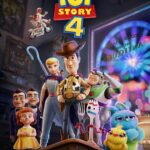
We can all agree that the first three Toy Story movies make up one of the best cinematic trilogies – one that crescendos to a wholesome, perfect finale for not only these toys, but the sense of play and adventure in us all. Then, 9 years later, Toy Story 4 emerged. And while it was a commendable release, it felt like a wholly unnecessary one. A send off for Woody, justice for Bo Peep, but ultimately a safe box office bet. Now, another 7 years later, we have the fifth installment. It’s not bad by any stretch but it has real spin-off, straight to video/streaming adventure energy. What’s more, in the same way the recent Disclosure Day felt like a naive 20th century movie released a touch late, the message here is equally poignant yet dated. Its heart is in the right place but the focus is quite scatterbrained and disconnected – almost as if there isn’t enough confidence in the narrative, so they have to concoct a ham-fisted subplot to ensure audiences don’t feel undersold. But more on that later.
Despite any misgivings I have about the discombobulated story, the voice acting is still on point and it’s genuinely great to see Joan Cusack being given centre stage. The trouble starts, however, when you look at the breadth of supporting roles and realise how little screen time they can viably be afforded. So let’s start with the new additions; the two most notable being a toilet training electronic game called Smarty Pants [O’Brien] and the aforementioned Lilypad [Lee]. While I have fundamental misgivings about a toy that teaches toddlers to use the toilet having the capacity to send emails (and spare me that tenuous “that’s just because they’re connected to the other devices” excuse), O’Brien is funny, engaging and fits right into the roster. Similarly, Lee is standout as Lilypad, who not only bridges the gap between what a toy and a device can provide for children, but also as a nuanced antagonist with wherewithal and a similar drive to do what’s best for Bonnie.
And then there’s Woody [Hanks] and Buzz [Allen]. The franchise was built off the back of these two and of course it’s nice to see them both back on-screen bickering away, but the reality is, they add incredibly little to the story. Feeling so vestigial and shoe-horned, their inclusion feels like desperate appeasement. Especially when the majority of the other ‘new’ inclusions are shunted even further down the ranks of importance, being thrown a few lines just to remind us that they’re here. It doesn’t help that, as previously mentioned, the story is a little fractured and chaotic, meaning we have an entire subplot following a squad of high-tech Buzz Lightyears who are initially marooned on a desert island before inadvertently trekking their way to our main characters. I get the reason for their inclusion (as a noted point about technology being more-and-more incorporated into toys) but the disconnect is so severe, and the running bit that all Buzz Lightyears fail to realise they’re toys, 31 years later, is derivative and cheap.
The truth is, the dilemma of each sequel after Toy Story 3 is how the script re-addresses toy obsolescence and abandonment. And the longer this narrative marches on, the more the villains of the original trilogy feel slightly exonerated. In both Toy Story 2 and 3, we were told by characters that no matter how much a child will play with a toy, eventually they will abandon them. Either for the next big thing, or because they’ll simply grow up. And, with Andy actively passing his toys onto Bonnie, it felt like we had the perfect close. The best case scenario. But in the quest for more money, each returning installment has to reassert this argument and is speaking more-and-more to the adults in the audience. The prime example here being Jessie desperately breaking down, saying, “I can’t love another kid just to find out I never mattered!” There’s only so many times you can pull that string and get a slightly different take on the same line.
**spoilers in this paragraph**
That being said, there’s a level of complexity and selflessness to Lilly that doesn’t exist in the other Toy Story adversaries. Sure, Lily is different, shiny, and new, and therefore is immediately at odds with the other toys, but she’s not the villain per se. Drawing a parallel between her and Anxiety in Inside Out 2. Rather than entirely demonising technology at large, the script is smart enough to highlight that the real threat is excessive screen-time, and kids being exclusionary and mean. What’s more, Lily does what no other villain has done to date, and actively donates herself in an attempt to make amends. Although, with Lily and Jessie being separated for the majority of the movie, the eventual handbrake revelation of “it’s ok for kids to grow up, we just have to be there for when they need us,” lands a little askew, as does Jessie’s newfound tolerance of anything technologically superior. Considering Jessie came to this epiphany thanks to spending time with other devices rather than Lily. A minor frustration born out of practicality but an irritation nevertheless.
Toy Story 5 is a distinct departure from the heights of the other installments. It’s unfortunately blunt, two dimensional and a little uncertain when it comes to its overall message. And while it makes good in the end, it has nothing like the emotional weight, complexity, and innovation of its predecessors. One for the die hard fans.
Release Date:
19 June 2026
The Scene To Look Out For:
**spoilers**
Without a doubt, the universally most memorable scene is going to be Jessie finding Emily’s memory box. One of the most heart-wrenching moments of any Toy Story feature is Jessie explaining being left by the side of the road. To soften the edges somewhat, this film retcons and redeems that event by having Emily name her daughter after Jessie. Necessary or not, it’s undeniably a tender, emotional commentary on the importance and impact of toys and the act of play.
Notable Characters:
As stated above, the cast is too sprawling and largely under-serviced. So, if anything, it’s the absence of characters that stands out more than any inclusion. Noticeably in how many are given silent cameos. Sure, all your favourites are back, but not really. It also serves to highlight how many actors since the original’s release have been replaced due to old age, availability or death, leaving the question of when exactly do we stop telling the tale of characters who don’t age when the voice actors evidently do. I imagine a lot of that answer will depend on how this movie performs at the box office.
Highlighted Quote:
“I was wrong about your kid, Blaze, she’s creative and silly in a way other kids don’t get.”
In A Few Words:
“Despite good intentions, Toy Story 5 feels like a marked step down from the franchise’s glory days.”
Total Score: 3/5