![The Red Right Hand Movie Reviews [Matthew Stogdon]](https://reviews.theredrighthand.co.uk/wp-content/uploads/2021/12/cropped-header1.png)
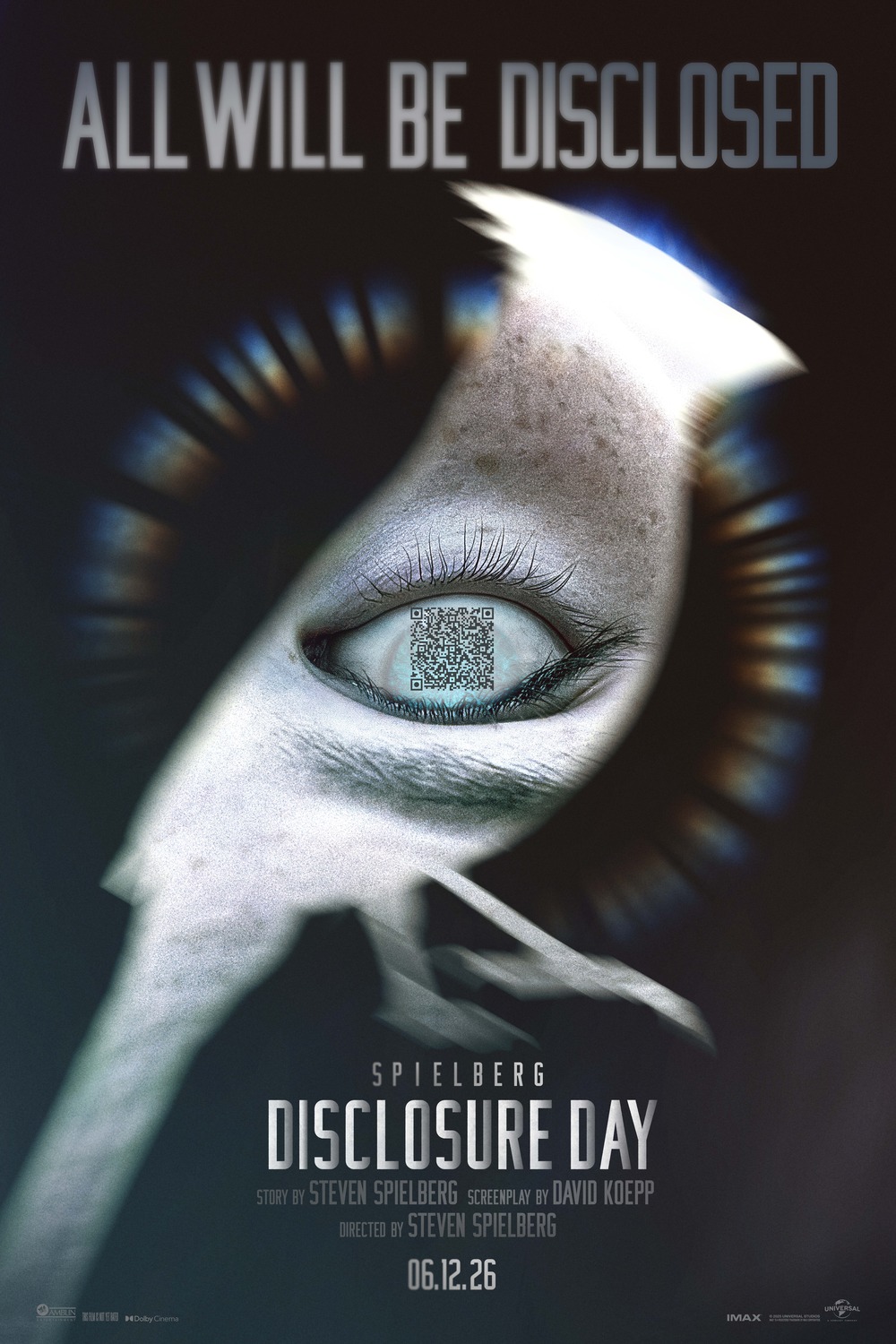
Director
Steven Spielberg
Starring
Emily Blunt
Josh O’Connor
Colin Firth
Colman Domingo
Kicking straight into the story, cybersecurity specialist, Daniel Kellner [O’Connor], is being chased down by the obscure, dubious corporation Wardex – headed by the imposing Noah Scanlon [Firth].
All because he’s stolen a cache of data and a seemingly dangerous artefact linked to extraterrestrial life. Simultaneously, TV weather presenter, Margaret Fairchild [Blunt], is suffering from a neurological breakdown that’s not only caused her to speak and interpret multiple languages, but also tapped into latent psychic abilities that allow her to probe people’s minds. With Wardex agents hot on their tails, Kellner and Fairchild find themselves drawn to one another, loosely guided by the mysterious Hugo Wakefield [Domingo].
On the surface, it would be easy to look at Spielberg’s oeuvre and draw comparisons with the mystery and fixation of Close Encounters Of The Third Kind and the frenetic tempo of Minority Report. But in actuality, Disclosure Day, is closer to The Post, in that on paper it has all the DNA of an engrossing, well executed feature, but for the calibre of filmmaker, it ultimately comes up short and fails to properly grab you; to the extent you forget it’s even a Spielberg movie. To be clear, this release is undeniably engaging and the pacing is extremely good, with two and a half hours sailing by, but once you lift the veil of this enigma, it’s surprisingly threadbare and remarkably recycled. Even John Williams’ score, while compelling, mostly feels like offcuts from Jurassic Park action sequences.
Where the film shines, is in the central characters’ complications and interplay. Through this we get plenty of high tension exchanges, bursts of comedy, and moments of genuine fear and panic. All of which is testament to the cast. From Firth’s menacing presence – most excitingly through alien tech possession, and a very nice iris changing effect to guide the viewer – to Colman Domingo’s passionate if cryptic words of support, “They regard empathy as an evolutionary advantage, the evolutionary advantage.” But it’s the dyad of Blunt and O’Connor that carries you through the entire runtime. Daniel embodies the drive and urgency of so many whistleblowers, while Margaret’s tonal whiplash from scrutinising insight to fervent abnegation, humanises the more inaccessible parts of her character.
Despite the scale and implications, Disclosure Day is quite a small, intimate movie with a limited cast of characters. Every now-and-then, there will be whispers of things happening around the world (apparently we’re on the brink of world war three) but none of it is really ever shown or, more importantly, felt. And in an era of AI and post-truth misdirection this film fails to reflect the landscape we currently live in – outside of a single dismissive line of dialogue. Making it a 20th century feature where TV networks and airwaves were king, and the X-Files logic of simply airing the truth, will change everything.
Pushing past this, we also have extensive religious allegory, all of which is pretty heavy handed, shoehorned and clumsy. Especially as the majority of this perspective comes in the form of Daniel’s new girlfriend and former postulant nun, Jane [Eve Hewson]. Early on, Jane is afforded a fair amount of runtime to pose some big questions about how humanity will interpret the existence of alien life – legitimate supreme beings revealed to many who have been raised in faith to worship a supreme being. But while it’s so concerned with a two and a half hour chase sequence, Disclosure Day has no real answers to said questions. Instead, it’s more preoccupied with indulging in all the classic alien ephemera, like crop circles, flying saucers, Roswell and little grey aliens with big heads. Leaving the entire production feeling oddly dated rather than a culmination of lore staples.
**spoilers within**
It also doesn’t help that Spielberg famously struggles to end some of his movies. If you take War Of The Worlds or A.I. Artificial Intelligence for example – both end unsatisfactorily with conveniences muscling their way through the third act, to simply draw the narrative to a comfortable close. Here, that takes the form of the titular disclosure. All of the pieces have converged into position to educate humanity on our place in the universe. And in the final moments, the Wardex group just give up. Whether due to an epiphany, psychic manipulation, or maybe just the sense that this true first contact is merely inevitable; it’s all incredibly lazy, rushed, and reeks of a first draft. And this conclusion then delves into complete indulgence with a prolonged revelation sequence that, while performed commendably, feels disconnected from our reality.
Looking back, there are so many positive and engaging moments that will grip you and stay with you long after the end credits roll. But the more you focus on the details, or apply any sort of stress or litmus test, so little of the movie holds up to scrutiny. With a lot of dated ideas, its optimism and wonder feel simplistic and naive. It never really shocks or surprises, nor does it meet any of the challenges or existential concepts it posits. It is an unquestionably big swing, but one that barely clips the ball, and is a far cry from the heady impact of Spielberg’s former releases.
Release Date:
12 June 2026
The Scene To Look Out For:
During one of many escape and evasion setups, Daniel and Margaret are in a car that’s pushed onto railway tracks and clipped by a freight train. With little option left, they’re forced out of the front window and onto the side of the train. But will they be able to get to safety before the oncoming train on parallel tracks reaches them? That’s not a question you need answering if you’ve seen any movie before, honestly. But the point I’m getting to, is that the sequence directly following this train collision action scene is decently done – launching straight into a well performed panic attack from Blunt. The pair bond and communicate well, with the camera staying with them as they try to compose themselves. A prime example of intimate moments that succeed in isolation.
Notable Characters:
**minor spoilers**
While she’s a focal point during the first two thirds, Jane is oddly forgotten until she reemerges when the script requires. It’s annoying and lacks grace but it mostly works. Wyatt Russell’s character on the other hand, Margaret’s boyfriend and point of light comic relief, is jettisoned in the first third and briefly returns at the end to tie things up neatly.
Highlighted Quote:
“I will not be anyone’s religion.”
In A Few Words:
“An intense race to ultimately very little.”
Total Score: 2/5