![The Red Right Hand Movie Reviews [Matthew Stogdon]](https://reviews.theredrighthand.co.uk/wp-content/uploads/2021/12/cropped-header1.png)
Director
Kane Parsons
Starring
Chiwetel Ejiofor
Renate Reinsve
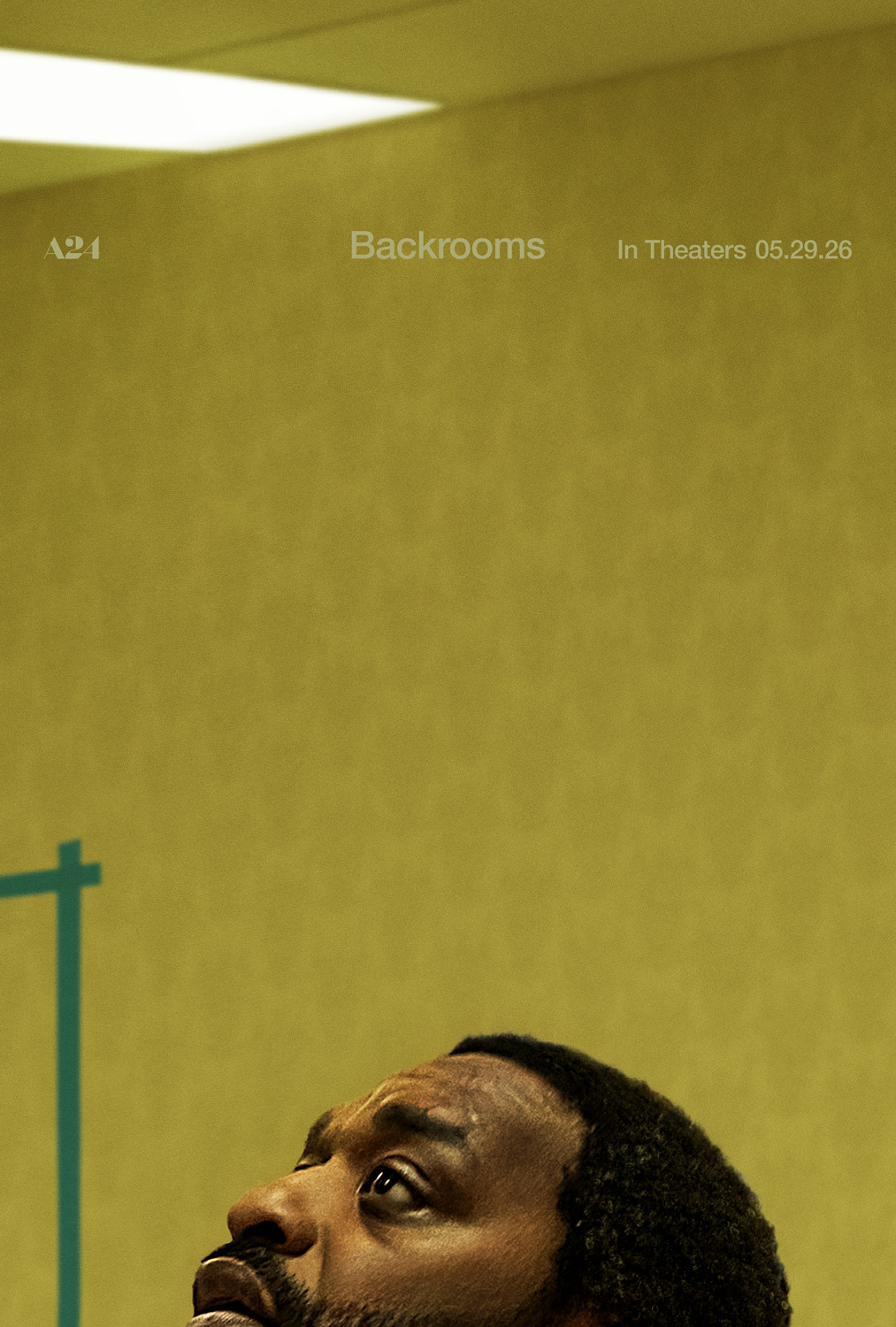
Set in the early 90s, furniture store owner Clark [Ejiofor] is struggling to get his life together. He has a drinking problem, his wife has left him, and his dreams of being an architect are eroding as he gets older; all of which he’s talking about in therapy with Dr Mary Kline [Reinsve]. However, Clark becomes deeply obsessed when he learns that, in the basement of his store, is a subtly hidden door that leads to an enormous complex of subterranean rooms. As Clark begins to explore, he quickly learns that the layout doesn’t really conform to logic and, more worryingly, that he’s not alone.
It’s impossible to review this film without talking about Kane Parsons’ age and his start on YouTube. There will be those that use that tidbit of information to make Parsons a poster child for young auteurs, while others will seek to tear him down, calling his work overly simplistic, or imply that “there’s no way a 20 year old made this movie”. But in truth, it’s worth caveating, because all the unmistakable inspirations and potential surface criticisms, should be softened in order to nurture this fledgling career. Less a pandering, just a sense of grounding that this feature, which is part Cube, part Us, part Blair Witch Project, is hopefully the start of a very promising career. Especially as the focus is a nostalgic look at a time just beyond the director’s lifespan. This isn’t Lucas trying to capture the feeling of the early 60s in American Graffiti, or Truffaut doing a semi-autobiographical take on an alter-ego in The 400 Blows, it’s more like Spielberg directing Empire Of The Sun. But those are some big, daunting names, and very different genre pieces, so let’s address the film itself.
The production design is entrenched firmly in the internet phenomenon of the existential horror of liminal spaces intended for humans yet devoid of life; constructed with an arrangement that doesn’t necessarily defy physics, but certainly convention and sense. And not just the titular rooms, but the real-world homes and nameless generic American town setting, even the pre internet technology, it all stirs a loosely remembered time and place, with the edges blurred and confused. And everything has been captured eerily from high CCTV angles, with erratic camcorder freneticism, or stalking shots that make shapes in the distance infinitely more unsettling.
While the story itself is incredibly clear-cut, the parables, myths, and media it draws on is intriguing. Case in point, when Clark first discovers the sliver of light leading him to the backrooms, there’s an ominous cardboard cut-out of a caveman speaking multiple languages. On the one hand, the tape it’s playing is the recording from the Voyager mission, and feels like humans trying to make contact with unknown life. But, to draw on a different influence, it also evokes a feeling of Theseus entering the labyrinth, following the cables like string, trying to avoid the Minotaur. However, the most striking comparison, in a very modern approach, is that of survival horror video games. From the compulsion to probe deeper into a clearly foreboding setting, to the clipping issues that cause random objects to impossibly sink until they’ve fused with the walls. And that’s before you get to Parsons and Edo Van Breeman’s soundtrack, which feels like it’s ripped straight out of a Silent Hill game.
The film is essentially held up by two performances, both delving into the psychological mazes and prisons we build ourselves. On the one hand you have Ejiofor’s character representing the evolution of the creepypasta YouTube origins, journeying with determination and gusto, trying to apply reason to madness. Whereas Reinsve feels more like the fleshed out character study that cinema ultimately requires and deepens the movie’s overall meaning and actual resonance with her childhood flashbacks and family medical history of psychosis. Sure, the handful of supports do a fantastic job, but the immersion is cemented thanks to Clark’s fixated monomania, and the listless dreamlike state that Mary seems to occupy. Both of which give room to wade through these hollow spaces, lost memories, sense of disconnection, and nostalgia in the true sense of the word – rooted in pain and loss for a time or place.
**spoilers within this paragraph**
It should be noted, that as much as this film burrows into your subconscious long after your initial watch, it’s far from a perfect feature. The whole Async Research Institute subplot and Mark Duplass’ scientist character feels slightly at odds with the rest of the movie. Granted, I appreciate this is drawing heavily on The Backrooms web-series and it’s meant to widen the lore by inferring there’s some unseen voyeuristic contingent making clinical observations and studies, but for a nearly two hour film, it still feels akin to afterthought bookends. That said, the link with Async making MRI machines, also exploring and mapping the human mind is a nice parallel to Mary’s psychoanalysis of Clark, it just feels a touch underdeveloped.
Curiously, there’s a lot you can dissect in terms of themes and subtext, and while so much of it is quite blunt and obvious, many mainstream, regular filmgoers are still going to feel lost. And while I lament the somewhat half-baked ARI element, there’s something to be said for a movie that doesn’t feel the need to explain itself, leaving the audience with more questions than answers, imbuing them with a sense of wanting to learn, understand and explore more – much like our ill-fated leads. Because, all faults and foibles aside, Backrooms, as an exploration of isolation, existential dread, nostalgia, and psychological scrutiny, is an incredibly bold, strong, and welcome piece of filmmaking. The tragedy is, with the wealth of young talent out there, cinema should be teeming with this kind of unique, quality production. But the entry point and excessive hoop jumping have too many creatives trapped on the internet, and we, as audiences and film fans, are robbed of potential marvels. But, in the meantime, we have this pleasing little oddity. And we should be quietly grateful.
Release Date:
29 May 2026
The Scene To Look Out For:
**spoilers**
When Mary first enters the backrooms and is choked unconscious, we see a vision of the camera falling through the floor of her childhood home. With each passing layer, all the personality and human impact are slowly stripped away, leaving the barren walls and nondescript spaces, only now with new traumatic gaps and dark patches in the form of shadowy doorways. A simple vignette that encapsulates so much of what this film is trying to say.
Notable Characters:
As stated, this movie is carried by the dual-lead of Ejiofor and Reinsve. But there are a handful of additional figures who briefly pop up. The most notable being Clark’s young employee Kat and her boyfriend Bobby (played by Lukita Maxwell and Finn Bennett respectively). Both are very uncomplicated individuals but they inject just enough youthful whimsy and light pococurantism as a pleasant juxtaposition to Clark’s jaded frustrations.
Highlighted Quote:
“There’s no fear, no pain, they simply exist, like furniture.”
In A Few Words:
“A fantastically executed exploration of unease.”
Total Score: 4/5