![The Red Right Hand Movie Reviews [Matthew Stogdon]](https://reviews.theredrighthand.co.uk/wp-content/uploads/2021/12/cropped-header1.png)
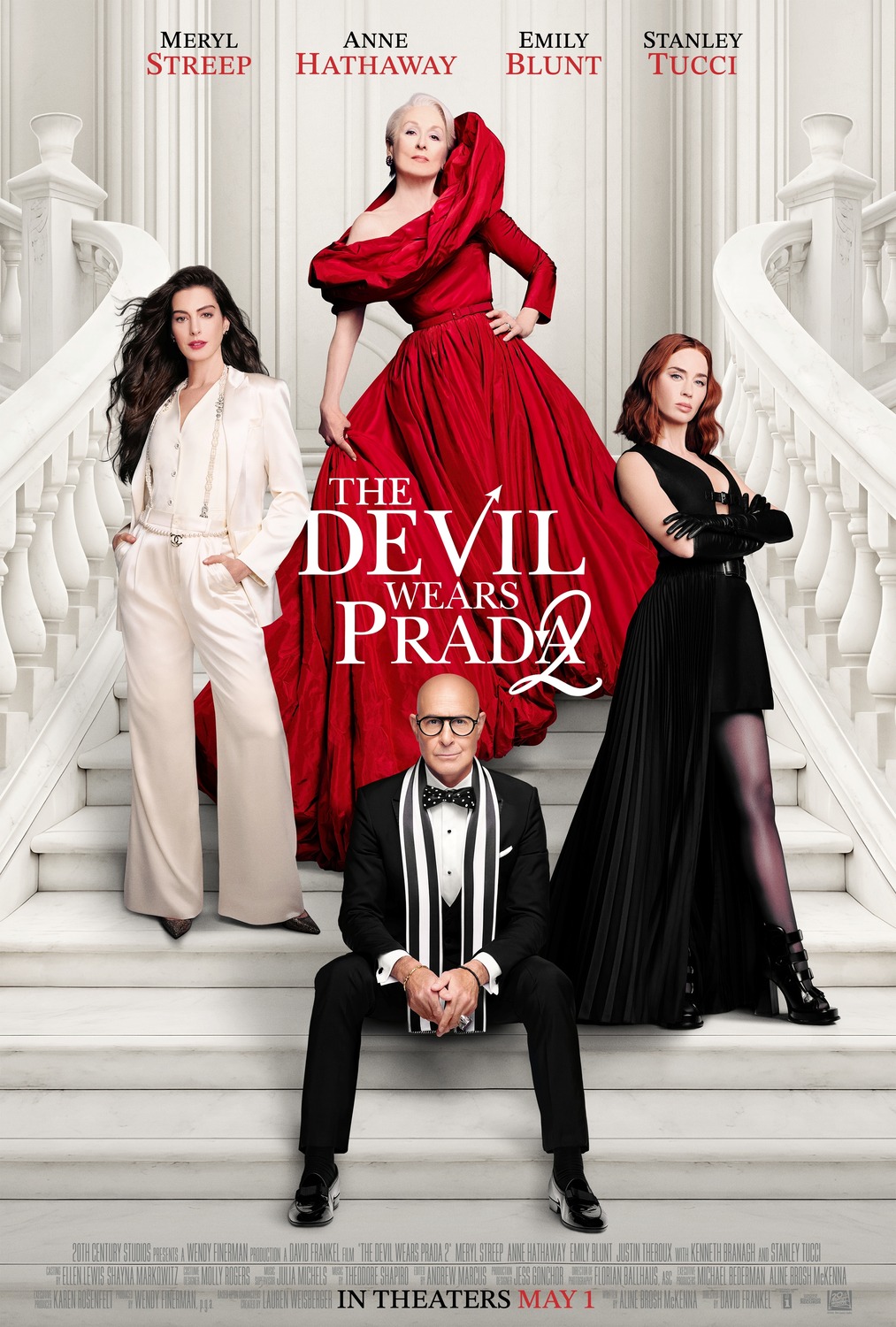
Director
David Frankel
Starring
Anne Hathaway
Meryl Streep
Stanley Tucci
Emily Blunt
Twenty years after her time at Runway magazine, Andy Sachs [Hathaway] is fired from her prestigious writing position for a major newspaper. However, due to an impassioned speech at an awards ceremony, Andy catches the eye of Runway’s parent company who parachute her in to help steer a scandal. This, of course, immediately rubs the magazine’s iconic director, Miranda Priestly [Streep] the wrong way. Despite Andy’s features gaining traction, management consultants are brought in to essentially overhaul and gut the magazine. This whips up a whirlwind of business intrigue and machinations as Andy et al try to save the company.
Getting the obvious out of the way, the central performances (that of Streep, Hathaway, Tucci and Blunt) are what everyone thinks they want. Even if it’s to the detriment of what this film could have been. See, there’s a comfortable familiarity that legacy sequels are often plagued with and, while little fault can be pointed at the cast who shine magnificently with what they’re given, this movie lacks challenge. Sure, all the catty venom and barbs fans will want is still technically present, but it’s all a little muted and not enough risks are being taken. What’s possibly worse, is that there’s no room for anyone new to shine. Granted, those aforementioned actors and personalities are big and it would be hard to crowbar in a new presence just for the sake of it. But to walk away from this release and not feel like we’ve gained a new favourite character is wasted potential.
In terms of themes, this film makes a curious commitment and sort of under-delivers on it. It positions itself as a stark look at the cost of living robbing us of artistic flourish, and dumbed-down online consumption ruining great visual and written material, but this film never really addresses the problem. We skirt around disposable fashion and disposable content impacting even the highest heights, but never the root cause. But even if the politics and economics aren’t being drawn into the conversation, The Devil Wars Prada 2 inadvertently talks about another issue at the heart of the 2020s experience: namely, that of an older generation that refuses to step aside, name a successor and relinquish power. And because this isn’t an intentional choice, the conclusions and unspooling of this conversation comes off tone deaf, continuing to infantilise professionals like both Andy and Emily [Blunt].
Additionally, this sequel performs an accidental character assassination. From a creative perspective, there’s a lot to enjoy about Miranda’s acerbic nature, but we can all agree that despite her knowledge and intuition, she was a monstrous individual; it’s why it’s so satisfying at the end of The Devil Wears Prada when Andy rejects this life. The problem here is, the script can’t decide if Miranda is a genius visionary or in charge of a failing empire. The ignition event that brings Andy back to Runway is resolved with one well-received but under-engaged article. And then we sort of drift through the second act looking for business management frustrations to entertain, rather than the manic beauty of the fashion world. Suddenly all of Miranda’s core strengths, the insight that makes her good at her job, are supplanted with c-suite executive schmoozing that makes her look amateurish at times. Toward the end of the movie, Andy makes an observation that was blatantly apparent from the first film and it opens Miranda’s eyes. Rather than a blindside revelation because she was too close to the issue, it just feels like bad management played off as a conveniently timed emotion ex machina. And don’t get me started on how they choose to close out the movie with a change of heart pivot that feels as forced and disingenuous as you can get.
**spoilers at the end of this paragraph**
Earlier I mentioned there wasn’t much room for new faces. And that’s not strictly speaking true. There is, in fact, a rom part of this former rom-com. But it feels so very shoehorned and superfluous. Less that Anne Hathaway and Patrick Brammall don’t have chemistry, more that their ‘relationship’ is so blunt and unrefined; to the extent it’s entirely unnecessary padding that could have been sidestepped entirely. But what’s truly baffling is the mishandling of the Emily/Miranda storyline. So much so that it’s buried as a twist despite being of more consequence and significance than Andy’s story. And while a spotlight on a spurned Emily is engrossing and shocking, as a villain she’s completely neutered. Neither spiteful or malicious, but not entirely justified in her actions either. All of which is made doubly ineffectual by the spineless reconciliation at the end. There’s so much room for genuine drama, confrontation, and rapprochement but we end up with is unbearably hollow.
And this extends to all of the script’s setups. There are no real obstacles, just distractions. And with a stronger focus on corporate manoeuvring over fashion, we get unrelatable business jargon and simple resolves over meaningful character development or consequence. From the outset, The Devil Wears Prada 2 laments the decline of magazines and newspapers, and the disastrous presence of vapid tech-moguls wading into the fray, but it doesn’t offer any solutions or hope other than “we live to fight another day.” So while it will entertain in the moment, it finds itself a surprisingly obsolete, forgettable imitation of a much meatier missed alternative; passable but a shadow of its former self. In a word, it feels inelegant.
Release Date:
01 May 2026
The Scene To Look Out For:
**spoilers**
So the big climactic third act is a fashion show in Milan but we’re never in any doubt that this will be a glorious success. More so, we don’t really get to revel in the show itself, because our focus is on Andy madly scrambling to pull strings and facilitate a purchase of the parent company. We don’t really see it, it just happens. And so, as the film draws to a close, despite my highlighted quote below and Andy’s fervent dedication to journalism, turns out, money was indeed all it came down to in the end.
Notable Characters:
Lucy Liu is in this film. More than that, she’s actually billed quite high in the opening credits. But her presence is remarkably superficial. Not as a cameo – this film has plenty of those – but as a ‘Holy Grail’ interview that Andy manages to secure with relative ease thanks to her now trademark dogged pursuit. And then a brief callback at the end that simply solves all of Runway’s problems. I can’t even say it’s laughably first draft because it just feels so neat and lazy. Not to mention, beneath the likes of Liu.
Highlighted Quote:
“Some things matter more than money! Journalism still fucking matters!”
In A Few Words:
“A pale reflection of what once was.”
Total Score: 3/5