![The Red Right Hand Movie Reviews [Matthew Stogdon]](https://reviews.theredrighthand.co.uk/wp-content/uploads/2021/12/cropped-header1.png)
Director
Aaron Sorkin
Starring
Mikey Madison
Jeremy Allen White
Jeremy Strong
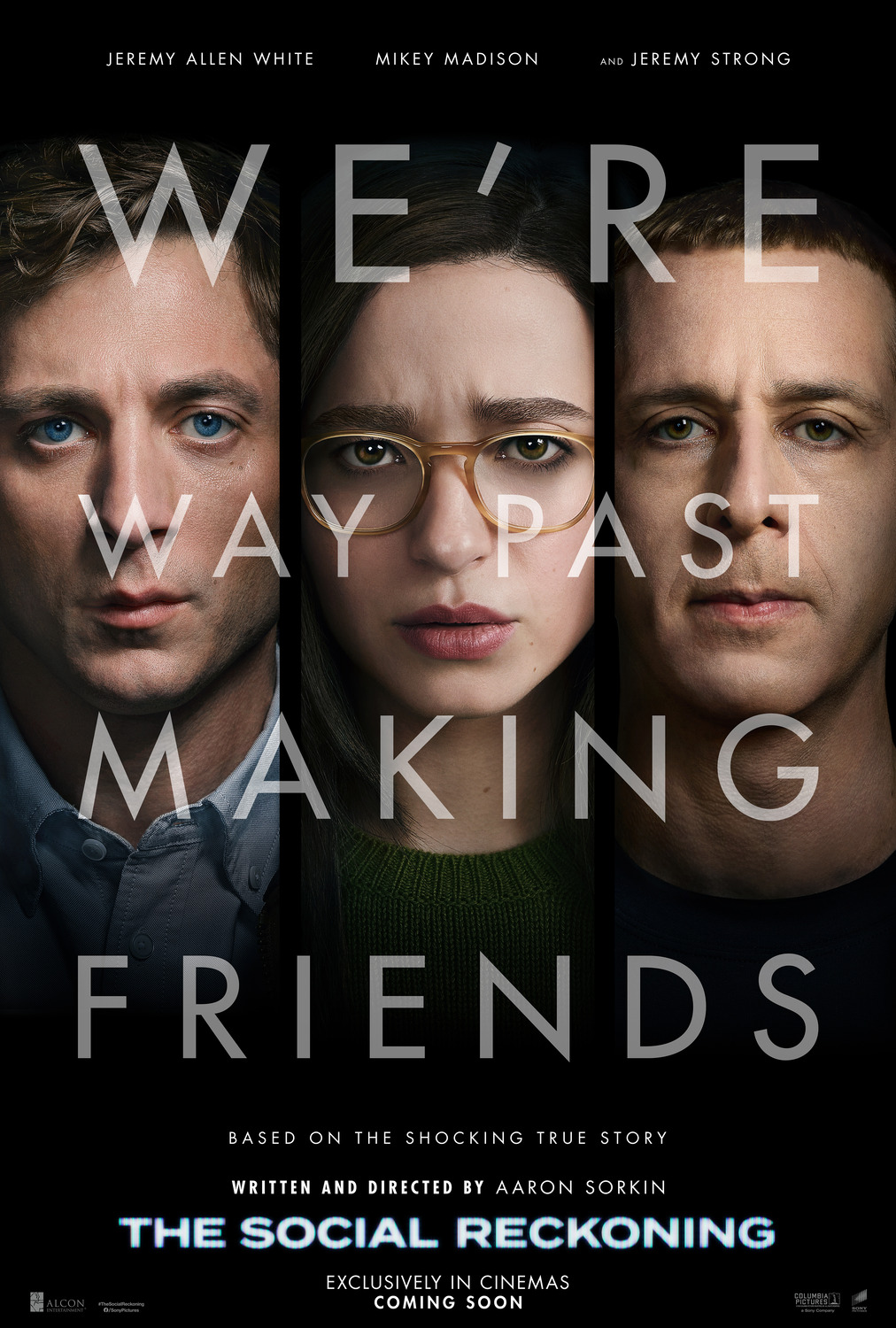
Darting back-and-forth between 2019 and 2021, The Social Reckoning splits itself between soon-to-be whistleblower Frances Haugen [Madison] leaking internal Facebook documents to reporter Jeff Horwitz [White], and Mark Zuckerberg preparing to testify before a US Senate committee. They are both arguably disconnected, yet share a linked causality. I could expand but that would imply there is tension and a post mortem breakdown of our current state of affairs. But, as we’ll come to see, sadly neither is the case.
Without question, Sorkin is an exceptional, seasoned writing talent – providing you enjoy his fast-paced, wise cracking, hyper-confident prose. His direction, however, is serviceable at best. All the camera movement and framing is fine but the jumping back-and-forth in the timeline is clumsy, to the extent that you become less engaged, and his overarching control of performances is wanting; leaving exchanges in the moment sometimes feeling out of place. What’s more, by the time the story starts to get into its stride, it quickly becomes apparent that we’re already deep into the third act, and the script is still desperately trying to make its most impactful points.
When writing both The Social Network and Steve Jobs (movies I enjoy that, coincidentally, had strong directors at the helm), Sorkin confessed he’s not technologically minded. But he doesn’t necessarily need to be. Because he seems to understand people, dynamics and engaging interplay. Do you need to understand Facebook coding to tell a story about an insecure college student? Do you need to understand computer manufacturing to explore the ego of a man like Jobs? Arguably no. Subsequently this makes the role of Horwitz one of the most blatant Sorkin self inserts in some time – a talented writer with full blown luddite. But it’s also clear that an ignorance of technology is not a brag worthy strength, it’s a liability. And Horwitz’s assumption that the political fields he’s used to operating in are somehow more dangerous is both short-sighted and reckless. Almost like a margin note that quietly admits “I wish I understood this more because it will be our end.”
Where The Social Network had a hub of strong central characters, The Social Reckoning is in desperate need for a clearly defined lead. Arguably, it’s Mikey Madison, but with the bisected structure and timeline, there are great inconsistencies at play. On the one hand, Frances is your typical Sorkin written character: quick witted, self aware, probably neurodivergent, and a contradiction of awkward but charming. On the other, she’s a caricature, an almost unbelievable figure. Then you have Jeremy Allen White’s Horwitz, who feels like a background inclusion. The man is hunting for a story and keen to expose Facebook’s machinations, but there’s no passion behind his actions. Lines are reeled off and exchanges are had in various hotel rooms, but either Horwitz or White come off as distracted, and at no point did I believe anyone was at risk or in jeopardy.
And then there’s Jeremy Strong, who’s arguably a fantastic fit for Zuckerberg… until you realise that the robotic portrayal of this man, while amusing, feels too exaggerated. Almost as if it excuses his actions – how can he be responsible, he’s clearly an alien. It remains unfortunate that Jesse Eisenberg was unwilling to return to the role, but even that connective tissue, wouldn’t be enough to explain how that kid quipping confidently in those private hearings about Facebook’s inception, became this megalomaniac, trying to convince everyone around him that he’s simply displaying a digital corkboard, not monitoring it. Sure, there’s a glimmer of that insecure young man – Zuckerberg continuing to hold on a grudge over a former employee’s writing of a damning op-ed parallels Saverin getting into the Phoenix club in The Social Network. But, frankly, we don’t see nearly enough of his journey and by reducing him to a supporting role, Zuckerberg is woefully underexplored and subsequently ends up a hollow parody.
But this movie’s greatest failure is that by narrowing its focus, it only scratches the surface. Sure, limiting the scope in Steve Jobs was a good framing tool, sidestepping the biopic trappings and presenting a novel three part comparison piece. Here, it simply minimises and unfortunately somewhat trivialises the major issues and ramifications, only alluding to them through interstitial segments. The reality we live in, is that Facebook at large has upended how we work, socialise, and view the world. Throwing a quippy line or two like, “I think you’re the best tool the bad guys have ever had” is fine but never cuts deeply or severely enough to expose the extent of the problem.
**Spoilers – sort of**
As these are all recent events, it’s odd to discuss the ending of this movie under spoiler tags. But it’s more about where the script chooses to focus. Essentially, the story ‘ends’ by culminating in a rushed crisis room, as the heads of Facebook witness the January 6th storming of the Capitol. But without a clearly established course from the outset, this event doesn’t hit with the impact it needs to. It should be a smoking gun. The damning evidence of “look at the horrors your works have wrought.” But instead, it comes off as smug and self congratulatory, as if these things are ancient history. The film insists “It’s gotta cause pain, it’s gotta hurt” but nothing present registers enough to elicit pain. But it wants its victory parade. And so closes with a truly tone deaf punching the air moment, as if to say “we didn’t get ’em but I feel good that I did the right thing.” It’s unwarranted, unjustified, and in light of Trump being reelected and Facebook continuing to be an unregulated cesspit with zero fact checking, any awareness it intends to generate is moot and lacklustre.
The concept of a sequel to The Social Network was never a bad idea, but it needed to continue Mark’s story. To merely shift focus and highlight a snapshot in time, leaves a lot to be desired. I think we can all agree, this is a story of our age with an urgent message at its core, but without the requisite bold personality to sell it, it’s just more background noise.
Release Date:
09 October 2026
The Scene To Look Out For:
As much as the story itself is a patchwork of mismatched moments, at only one point do Mikey Madison and Jeremy Strong share a scene. She’s very much an underling in Mark’s Bond villain office visit, but it offers a brief look into this strange world he’s built for himself. As Frances highlights the bulletproof couches to hide behind and the host of muscular henchmen pretending to type at keyboards. It’s all a facade and a reflection of fear, but not one that’s given enough time to breathe.
Notable Characters:
Amongst the altruistic legacy media print journalists and crisis management teams at Facebook, some of the most human interactions come from Bill Burr as Charlie Garrigan. A former employee with the confidence to speak to Mark as an equal and warn him about what he’s walking into, but unfortunately reality doesn’t align as well, and this insert/amalgam ultimately fails to move the needle.
Highlighted Quote:
“You’re like a crossing guard standing in front of the school but you’re not doing anything with your arms so the cars are just ploughing down the children!”
In A Few Words:
“Neither powerful warning siren nor insightful critical evisceration, it’s all just a bit lukewarm.”
Total Score: 2/5