![The Red Right Hand Movie Reviews [Matthew Stogdon]](https://reviews.theredrighthand.co.uk/wp-content/uploads/2021/12/cropped-header1.png)
Director
Maggie Gyllenhaal
Starring
Jessie Buckley
Christian Bale
Annette Bening
Penélope Cruz
Peter Sarsgaard
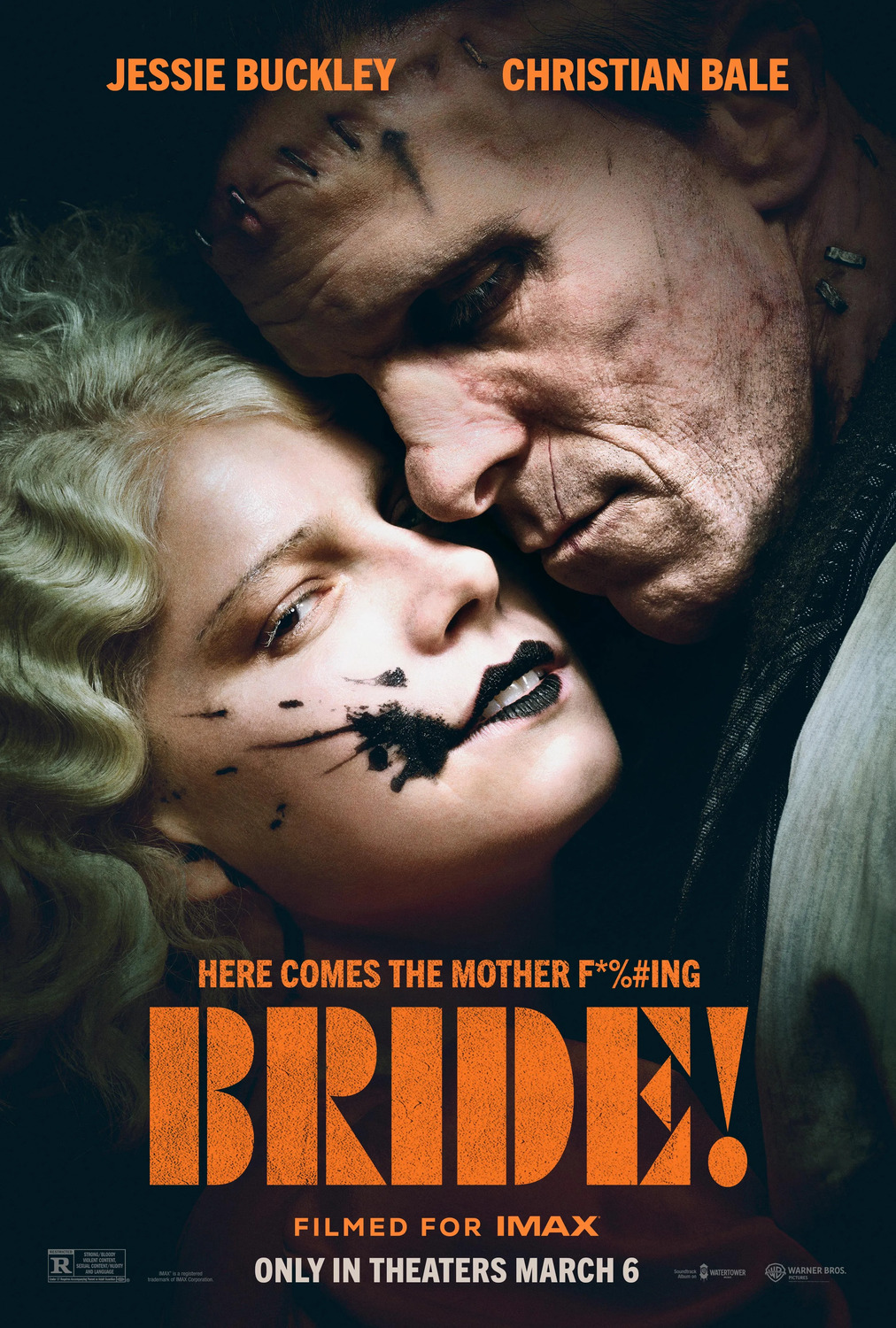
Set in the late 1930s, we witness the death of Ida [Buckley], a woman wrapped up in the criminal activities of the mob. Shortly after, we’re introduced to Frankenstein’s monster [Bale] as he visits renowned scientist, Cornelia Euphronius [Bening], who has been studying the grim art of reanimation for years. Explaining he’s lonely and requires a mate, the pair dig up Ida’s body and bring her back to life. And so the newly formed couple start their turbulent relationship in a Bonnie & Clyde-esque fashion – replete with violence, self discovery, and sexual upheaval. And if it wasn’t apparent from the phrasing of this short synopsis, this movie is something of a muddled, shambling feature that is ultimately, in a word, disappointing.
There is, of course, one major aspect of this plot that I have left out. One that could be construed as a spoiler but is such a glaring example of how bold yet flawed this movie is, that it needs to be talked about separately. Whether this was always the intention, or if the final film was simply found in the edit, The Bride opens with a straight-to-camera, fourth wall breaking monologue from the afterlife. Namely, the disembodied soul of Mary Shelley [Buckley] restlessly rewriting Frankenstein… by possessing a 1930s socialite. See, the impetus for this entire film is to correct the fact that in the 1935 feature The Bride of Frankenstein, the eponymous bride is a neglected, underwritten presence. A prop, more than a person. But this approach takes a lot of liberties when it comes to Shelley’s motivations and perspective. And with minimal probing, the logic collapses entirely. We’re led to believe that Shelley wants to tell her story, and in doing so, gets a woman killed, so she can possess her body, and (completely divorced from this narrative) happens to link up with her own fictitious creation, who somehow exists in this world. I can happily admit, it’s undeniably daring, I just don’t think it’s particularly good.
Oddly, there’s a direct parallel comparison with the recent adaptation of Wuthering Heights. In that instance, Emerald Fennell clearly didn’t understand the source material and stripped all of the themes to make a raunchy extended music video. Whereas here, Gyllenhaal has made her own creation with bombastic thematic choices, they simply lack the coherence to come together satisfactorily. Yes, this is a story of consent, projected ownership, and the consequences of being a loud, confident, disobedient woman in a patriarchal world; culminating in said woman screaming/pleading “me too!” But it’s also a mess of contradictions and myriad references that fail to coalesce. Which isn’t helped by a lack of a through-line. It’s evident that Ida (who eventually goes by Penelope) is pulled to and fro by the men around her, and reframing the Frankenstein story through a “the emotionally unstable nice guy” lens is a very good, contemporary take. But the script sometimes forgets that. And in an attempt to highlight conflict and frustration, we are presented with confusion and handbrake turns that feel uncertain and, honestly, unearned.
That said, if we strip away the story of this piece and simply look at the components, there’s a lot to love. Hildur Guoðnadóttier’s score is aggressive, eerie, wild, and unsettling; feeling like an extension of her work on the Joker films. The production design is transportive and engrossing, with a look for the bride that is unique while simultaneously paying homage. And there are references aplenty; not only to Frankenstein and its multiple iterations, but also 1920s and 1930s cinema as a whole. The primary issue is that, if you know what to look for, these references are far from subtle – the use of “Putting On The Ritz” to evoke Young Frankenstein for example.
As for performances, the entire cast is committed, to say the least. Buckley gives a truly fearless portrayal, and, quite frankly, in the last few years has proven herself an utter tour de force. To the degree that even the most absurd choices within this movie fail to tarnish that power. For one of the most portrayed characters in all of fiction, Christian Bale doesn’t exactly have huge scope to do something new as Frankenstein’s Monster but what is being done, is nuanced and engaging. However, outside the central roles, we do have a handful of inclusions that just don’t sit right. Case in point, around a third of the way through the feature, the hunt for Frankenstein and the Bride is headed up by Detective Jake Wiles [Sarsgaard] and his canny assistant, Myrna Malloy [Cruz]. The inclusion of these two feels like such a crowbarred afterthought, with a series of revelations and connections that come off as forced and haphazard. This isn’t a cat-and-mouse tale, more an adjacent course correction; the product of rewrites to help the themes come together. Unfortunately, with limited success.
Frustratingly, for a film that wants to elevate the role of women in genre films, this movie inadvertently makes its few female characters two dimensional and cartoonish. We have Bening’s presence as the mad scientist to say “look, women can be crazy pioneers too” only to have her motivation driven by her husband’s death, Cruz is eventually whittled down to a caricature of an aspiring detective up against the system, and for all her defiance, Buckley’s Bride doesn’t have the sense of closure and evolution that an audience would want. See, I genuinely wanted to like this movie but it’s so erratic and there are too many conflicted, underdeveloped personalities and storylines struggling for dominance.
The problem is, this is an actor’s playground but the lack of boundaries leads to an absence of consistency and clarity. Fundamentally problematic is that it can’t really decide on what the relationship between Frankenstein and the Bride should be – does she take ownership of her situation by forcing the same thing on Frank or is that merely a hypocrisy? Is Ida’s possession by Mary a way to have control over how art is perceived once it leaves the author’s pen, or an illustration of how our creations consume us? Are the expectations of love complicated and worth nurturing, or are they a forced fantasy that corrupts and obliterates? One could argue this is a reflection of human complexity, but in truth it just feels like circular writing that wants to say more than it actually can.
Overall, The Bride is beautiful and desperately wants to be unique but it’s oversimplified, self aggrandising, presumptuous, and disappointing. There will be those who appreciate the effort and see past the limitations to enjoy what has ended up on-screen, and others who feel the weight of the runtime as this feature struggles to convey what it wants to say. Regardless, The Bride’s lasting legacy will likely be that while many creators look down their nose at genre pieces, they are, in fact, remarkably difficult to pull off effectively and meaningfully. And, more often than not, miss the mark.
Release Date:
06 March 2026
The Scene To Look Out For:
**Spoilers**
A subplot present is that Frankenstein loves the cinema. More so, he has a parasocial relationship with a film star who overcame childhood disability to become an icon. Finally coming face-to-face with his hero in New York, the creature is overcome with emotion and lashes out. This then segues perfectly into a heightened monster dance that consumes the dapper Manhattan party. On the one hand, it comes off as an alignment of the characters’ shared madness and feels dreamlike. But this is then shattered and wrenched back to the somewhat hamfisted “the mob boss is killing all the women and the police are in on it” plotline; serving as a microcosm for the entire undertaking’s flaws. It desperately wants to be creative and untethered but is bound by the constraints of its own design.
Notable Characters:
Introduced from the outset, there’s a gangster connected to Ida, named Clyde (portrayed by John Magaro). He’s weak, ineffectual, and in over his head. But he keeps popping up with the promise of having an impact on the story. From the start, we believe he’s the one who pushed Ida down the stairs. But, from the way the film is shot, it looks like Mary’s possession was in fact responsible. He is sent to kill the bride (again) but solely acts as witness to what’s happening. Every time there’s an opportunity for him to step in and haunt Ida, a gunshot rings out from a random police officer. He is, very much, an appendix. A vestigial remnant of potentially abandoned and reshot plot points.
Highlighted Quote:
“I would prefer not to.”
In A Few Words:
“A thoroughly ambitious cocktail that fails to find its footing.”
Total Score: 2/5