![The Red Right Hand Movie Reviews [Matthew Stogdon]](https://reviews.theredrighthand.co.uk/wp-content/uploads/2021/12/cropped-header1.png)
Director
James Cameron
Starring
Sam Worthington
Zoe Saldana
Sigourney Weaver
Stephen Lang
Britain Dalton
Jack Champion
Oona Chaplin
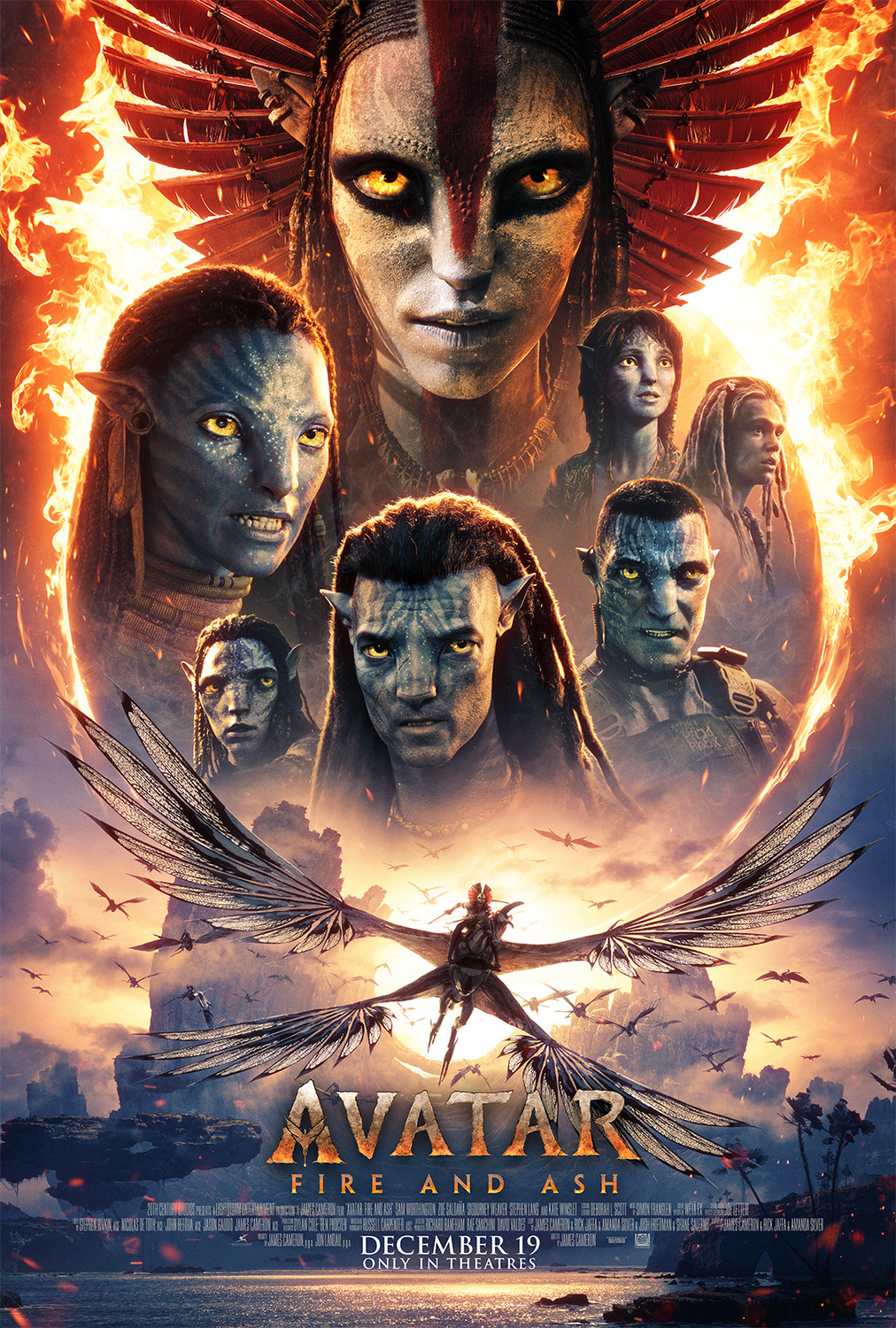
Shortly after the events of Avatar: The Way Of Water, Jake Sully [Worthington] is trying to convince the water-dwelling Na’vi tribe to prepare themselves for battle, because the forces led by the quasi-resurrected Col Quaritch [Lang] are going to return for retribution. But they are still resistant. Meanwhile, despite Quaritch’s son, Spider [Champion] wanting to stay with his surrogate family, his reliance on a mask to breathe makes it impractical and it’s agreed he will have to stay with the other Na’vi-aligned humans at a research facility. En route to this location, the group are attacked by a rival faction of Na’vi – a fire worshipping piratical offshoot – led by the malicious Varang [Chaplin]. This encounter kickstarts a series of separations, alliances, and rushed developments (in this case, Spider being able to breathe Pandoran air) that will define this entire adventure.
As stated in my previous Avatar review, to rate these films as truly atrocious is an act of foolishness because one need only highlight the visual achievements, and instantly concessions must be made. You can criticise every single aspect of this film (and I will in due course) but there is undeniably a lot of spectacle which continues to boggle the mind and delight the senses with how much care, attention, and skilful flare it has been given. In a word, Avatar is stunning. Always has been, always will be. But that’s where the glazing ends because every other aspect is either woefully subpar or bland at best. From the ground-up, the writing is base level, the dialogue is agonising, and the themes are surprisingly jumbled. It’s a mindnumbingly dull story that takes so long to do anything, and excessively revels in its visual accomplishments, forcing multiple victory laps midway through the race. For some key examples, we’ve got Lo’ak’s character arc torn between “I need to find my own path and voice to redeem myself” and “I solely need to prove myself to my father”, and Quaritch wrestling with “I’m neither the man who came before, nor an instrument of those puppeteering me” and “I’m just an evil henchman”. Both of which can absolutely be utilised to tell an interesting story, but here they are crutches that force scenarios with uncharacteristic hairpin turns; most notably snapping from an insatiable bloodlust to a fragile partnership and monologuing. It just smacks of rote writing and utterly cripples any suspense.
Speaking of characters, let’s get into them because with such a sprawling cast, each new installment pivots the story toward an unlikely central focus. In the first film, Jake is undeniably the protagonist and audience insert. But as events continue, his presence feels more like a tool than an agent of action; a device to push peripheral narrative points rather than develop in and of itself. Instead, the Sully’s second-born child, Lo’ak [Dalton], is the driving force. And on paper this is fine. He’s a child of two worlds, connecting with fellow outcasts and miscreants, and struggling with the loss of an older sibling, for which he blames himself. Everything about him screams ‘interesting lead’. The problem is that the execution is lacking, Dalton’s performance is a little malnourished, and his trite observances through voiceover narration only highlight where the film needed to fast forward or stitch over a clumsy edit point.
But, as it turns out, Lo’ak isn’t really the lead character. He shares that focus with one of James Cameron’s worst creations: Spider the weird man child. Through a combination of abhorrent dialogue, an infuriating performance, and the most ridiculous plot armour, Spider is a cringeworthy inclusion. At the end of the last movie, Spider’s conflict and actions lead to the adversarial Quaritch surviving. We should chide Neytiri [Saldana] for her, frankly racist, view of Spider, but it’s hard to disagree when he’s so deplorably awful to watch. And for those who have yet to see the movie, you may feel this is hyperbolic and excessive, but he’s the definition of a teenager written by a 70 year old man, and it’s exhausting and painful to watch.
Moving over to the supports, Jake and Neytiri continue to be terrible parents relegated to b-plots and lazy sad dad / crazy mum stereotypes. But most surprisingly, the human component is still pretty underdeveloped. I was convinced that with films two and three shot back-to-back, that we’d have a deep dive into the water tribe in the second film, only to circle back to the human invaders in the third part. And while that’s partly true, their presence is more a location than a fully explored and rounded antagonistic presence. Edie Falco as the overseer General is insanely two dimensional, Brendan Cowell the whaler (in all but name) is just as cartoony as he was in the last film, and Giovanni Ribisi pops his head up to thread these films together – mostly in a “remember this guy” way.
The unforgivable sin this film commits is wasting Oona Chaplin in what should have been this franchise’s most interesting inclusion. In terms of performance and presence, Chaplin is a phenomenal addition, injecting a compelling, sinister energy to the heretical Varang. The way she moves, composes herself, talks, it all draws you in and adds a dash of grey to the very morally black-and-white Na’vi. This is an individual whose people were almost wiped out by natural disaster and she has therefore turned her back on the religious roots of the planet. So for the first act, she is a terrifying force, as well as a potential source of corruption for our jaded leads. That is, were the film to continue this logic, and not simply abandon it in a heartbeat. See, the script falls foul of a warrior queen trope that I despise. Namely, a male lead approaching a very capable and dominant female presence with the line “you don’t want a subordinate, you want an equal.” Which then acts as permission for said male character to simply take over and have this interesting figure as a hissing side ornament.
Even if you can excuse the above and simply enjoy these films for the escapism and wonder, you cannot deny how excessively indulgent they have become. The first Avatar movie admittedly had the grace to be reasonably paced, but with the prospect of multiple sequels to stretch out a pretty flimsy story, the entire journey is padded with bloat. If you were to write out all the story beats and character trajectories, you could have easily condensed both films’ core points into one really tight, action packed 3 hour epic. Instead, we’re given another go around with what is brazenly the structure and setting of the second movie. And this is where the whole Avatar experiment unravels. The key selling point for these movies has always been offering audiences something hitherto unseen. “Come to the cinema and you will witness a world unlike any other.” Yet, despite all the time and supposed development, this franchise has nothing new to show. I will give credit where it’s due and doff my cap to the unparalleled effect work, but with such a recent outing to this world, what is your main selling point? What do you have to draw us back in? Because it’s certainly not the story or the characters. And no single air-blimp sequence or army of squids is going to cut it.
To round off this review, it’s hard for me to critique the handful of unfinished plot threads or character fates, because this was written as the third part of a pentalogy. But given the eye-watering sums of money it takes to create and promote these films, it’s hard to say whether Avatars 4 and 5 will ever see the light of day. If that is the case, this serves as a weak but arguably satisfactory conclusion, with just enough resolution to close the book on this world. If not, whatever comes next has to work overtime to justify returning in a meaningful and impactful way.
Release Date:
19 December 2025
The Scene To Look Out For:
**Spoilers**
During the film’s final showdown, Kiri [Weaver] connects to the mycelial network and comes face-to-face with their goddess: Eywa. And I have to confess, the reveal of this monolith deity was actually impressive: that perfect combination of terrifying and awe-inspiring presence paired with a mysterious and ethereal presentation. After three solid hours, it was the first time I sat up in my seat and was sucked in by something new and bold. Frustratingly, it was scuppered almost immediately after by a giant explosion severing the connection. Now, I can appreciate this could be the tease that returns in later chapters, but considering I’ve spent an arse-numbing 9 hours of build-up, I feel we deserved more.
Notable Characters:
As with the first film, Miles Quaritch continues to be the most captivating part of these movies. Lang is clearly having a great time and leaning into all the big bad guy tropes, while a little predictable, is honestly enjoyable. I don’t care for his flip-flopping of whether he wants to kill someone or not solely due to script dictation, nor do I like him utterly sidelining Varang. But the performance is engaging enough to almost excuse those things.
Highlighted Quote:
“When you ride the beast you become the beast. And the more blood the better.”
In A Few Words:
“The weakest outing thus far as Pandora’s sheen wanes.”
Total Score: 2/5